General information only — not medical advice. BNCT is a highly specialised treatment that is only suitable for a small number of people, in a small number of centres. Please follow your own treating team’s advice.
You may have heard BNCT described as a very targeted form of radiotherapy. It is different from standard radiotherapy in how it works, and it is not available everywhere. This article explains, in plain language, what it is, who it is for, and what is still unknown.
What is BNCT?
BNCT stands for Boron Neutron Capture Therapy. It is a two-part treatment:
- A boron medicine is given first. Boron is a natural element. The medicine used in BNCT contains a form of boron called boron-10. It is given as a drip into a vein, and cancer cells take up more of it than most normal cells do.
- A beam of neutrons is then aimed at the tumour. Neutrons are tiny particles. On their own, at the low energies used here, they do little damage. But when a neutron meets a boron-10 atom inside a cancer cell, the two react — and that reaction releases energy right there, inside that cell.
In other words, the boron medicine marks the cancer cells, and the neutron beam sets off the reaction only where the boron has collected. The energy released travels only a very short distance — roughly the width of a single cell — so it mainly damages the cells that took up the boron, while nearby normal cells are more likely to be spared. That is why BNCT is sometimes described as cell-level targeting. It is not the same as proton therapy, and it is not a stronger version of standard radiotherapy. It is a different way of delivering radiation to the tumour.
How is the treatment given?
BNCT is only given after a careful assessment, because it suits very few people. If your team thinks it may be an option, the steps usually look like this:
Referral and assessment. Your oncologist reviews your scans, your previous treatments, and your general health, and discusses your case with the BNCT centre. Not everyone who is referred is accepted for treatment.
Scans and planning. Scans are used to map the tumour and the healthy tissue around it, and to plan the neutron beam. Some centres also do a test to check how much boron the tumour takes up.
The boron drip. On the treatment day, the boron medicine is given slowly through a drip. You will be monitored while it is given.
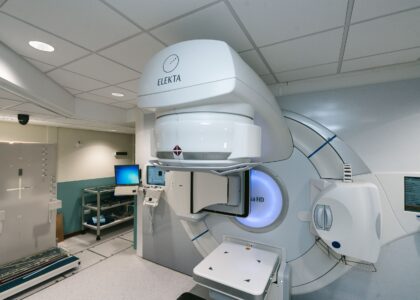
The neutron beam. While the boron is still in the tumour, the neutron beam is aimed at the treatment area. You lie still on a treatment couch, much as you would for standard radiotherapy. The team watches you from outside the room, and you can talk to them throughout.
A small number of sessions. BNCT is usually given in one session, or in a small number of sessions, rather than over many weeks like standard radiotherapy. Your centre will tell you what to expect for your situation.
After treatment, you will have follow-up scans and clinic visits to check how the tumour has responded and how you are recovering. The team will also watch for side effects, which can appear weeks or months later.
Who might BNCT help?
BNCT is mainly used for cancers that have come back in a place that has already had radiotherapy, where giving more standard radiotherapy is difficult because the healthy tissue nearby has already received as much radiation as it safely can. The best-established use is for:
Head and neck cancers that have come back, or that cannot be removed by surgery, after previous radiotherapy.
For other cancers — for example, some brain tumours — BNCT is still being studied in clinical trials. It is not a treatment for every type of cancer, and it is not used for cancers that have spread widely through the body. Your team will consider many things before suggesting BNCT, including the size and position of the tumour, how much boron it takes up, what treatments you have already had, and whether you are well enough to travel for treatment.
What do we know — and what do we not know yet?
It is an approved treatment in one country. Japan approved BNCT in 2020 for head and neck cancers that cannot be removed by surgery and cannot be treated with standard radiotherapy, and it is covered by Japan’s national health insurance for that use. Japan is the only country where it is approved as a routine treatment in this way. Elsewhere, it is still mainly in trials. Centres in several other countries are studying BNCT, but outside Japan it is generally only available through a clinical trial or a special referral.
The evidence is still limited. The results so far are encouraging for the small group of people it suits, but the studies have been small, and we are still learning about long-term results — how long the benefit lasts, and what the late side effects are. BNCT is not a proven cure, and it does not help everyone who receives it.
New boron medicines are being developed. Researchers are working on medicines that may carry boron into tumours more effectively, and on extending BNCT to other cancers. These are still experimental.
Side effects:
Because BNCT aims to spare normal tissue, the hope is that side effects will be fewer than with another course of standard radiotherapy. But side effects can still happen, and some can be serious. They depend on where the tumour is, and on what treatment you have had before. Possible side effects include:
- Soreness in the mouth or throat, and difficulty swallowing, after head and neck treatment.
- Skin redness, dryness, or soreness in the treated area.
- Swelling in the treated area.
- Tiredness.
- Hair loss where the beam passes through.
- Dry mouth, or changes in taste.
Serious side effects are possible, particularly in tissue that has already been irradiated before. Your team will explain the risks for your situation, and will monitor you closely after treatment. Tell your team promptly about any new or worsening symptoms.
Is BNCT available in Singapore?
There is currently no BNCT centre in Singapore, so patients who are considered for BNCT need to travel — most often to Japan, where the treatment is established. Your oncologist can advise whether a referral is appropriate, and can help with the records and scans the overseas centre will need. Travelling for treatment takes planning — time away from home, family arrangements, and costs, which vary and are not always covered by insurance. Ask your team, and the BNCT centre, about what is involved before making any plans, and do not book travel until the centre has confirmed that you are suitable and has given you a treatment date.
Questions to ask your team:
- Am I someone BNCT could help, or is standard treatment or a clinical trial a better option for me?
- Has my tumour already had as much standard radiotherapy as it safely can?
- Would I need to travel, and where to?
- What would the whole trip involve?
- What results and side effects should I expect, based on my situation?
- What happens if BNCT does not work, or if I am not accepted for it?
- Is there a clinical trial I should consider instead?
The bottom line:
BNCT is a clever and very targeted idea: a boron medicine that collects in cancer cells, plus a neutron beam that triggers a reaction only there. It offers a real option for a small group of people — mainly those whose head and neck cancer has come back after radiotherapy and cannot be removed by surgery. But it is a specialised treatment, available in very few places, with evidence that is still growing. For most people, standard radiotherapy, surgery, medicines, or a clinical trial remain the right options. Your team can help you weigh them up.
This article is general information for patients and families. It does not replace advice from your own doctor, nurse, or radiographer. If you are unsure whether BNCT could be relevant for you, please ask your treating team.